-
SW FL Regional Ecosystem Restoration Plan
( 1 Article )
In August 2012, the three Southwest Florida National Estuary Programs agreed to develop one list of priority environmental projects for consideration by the Gulf Coast Ecosystem Restoration Council and the State of Florida. Cities, counties, non-profit organizations, universities and other institutions were invited to submit project information. The 280 proposals received were rigorously reviewed, vetted and ranked by technical and science advisers, using criteria defined by the Gulf of Mexico Ecosystem Restoration Strategy and the RESTORE Act. The final regional ranked list was approved on March 8, 2013 by the elected officials and agency representatives comprising our Policy Boards.
-
Old Tampa Bay Evaluation 2011-2014
( 3 Articles )

The Old Tampa Bay segment has been identified as an area of primary concern through several Tampa Bay Estuary Program (TBEP) research initiatives and advisory committee recommendations. Unlike the other six major bay segments of Tampa Bay, periodic poor water quality conditions and limited seagrass expansion are still observed in Old Tampa Bay. Recent results from a cooperative project between the TBEP and Southwest Florida Water Management District (SWFWMD; Peebles et. al, 2009), two Pinellas County Environmental Fund supported studies in the Feather Sound region of Old Tampa Bay (Griffen and Greening, 2004; Cross, 2007) and the reoccurrence of a spring/summer algae bloom in the upper portions of Tampa Bay during 2008 and 2009 (more information) indicate that a more comprehensive assessment is needed for this subwatershed and bay segment.
In order to effectively characterize the primary factors stressing Old Tampa Bay, TBEP staff has worked with faculty at the University of South Florida and the TBEP Technical Advisory Committee (TAC) to develop a conceptual framework that will guide research and management decisions for this bay segment (Figure 1 above). This assessment framework is similar to approaches utilized in the Comprehensive Everglades Restoration Plan (CERP; Ogden et. al 2005) and helps define major working hypotheses and cause-and-effect relationships for the ecological processes within this bay segment. The TBEP has garnered input from its TAC through a series of meetings and online surveys to determine where research should be focused in the future based on this initial framework. These new modeling and evaluation efforts will aid in identifying specific management actions that can be implemented to remediate the poor conditions observed in Old Tampa Bay.
As a result of these efforts, the TBEP and SWFWMD have committed future funding to the development of a comprehensive assessment for Old Tampa Bay. The assessment will include the development and application of an integrated watershed loading, hydrodynamic/water quality response, bay circulation, and possibly biological productivity model or a combination of mechanistic or empirical modeling approaches that consider variations and modifications in nutrient inputs, hydrologic inputs, and in-bay circulation. The integrated tool will be used to assess the net biological response (e.g. algal abundance, seagrass acreage, dissolved oxygen conditions, etc.) in Old Tampa Bay to variations in these ecosystem drivers. The comprehensive assessment for Old Tampa Bay envisioned by local bay managers will include the development of a comprehensive modeling tool that integrates nutrient loading, circulation, water quality, and biological responses and facilitates quantitative evaluation of specific restoration options under various management strategies.
-
Feather Sound Tidal Wetland Restoration
( 0 Articles )
-
Tampa Bay Ecosystem Services Project
( 2 Articles )

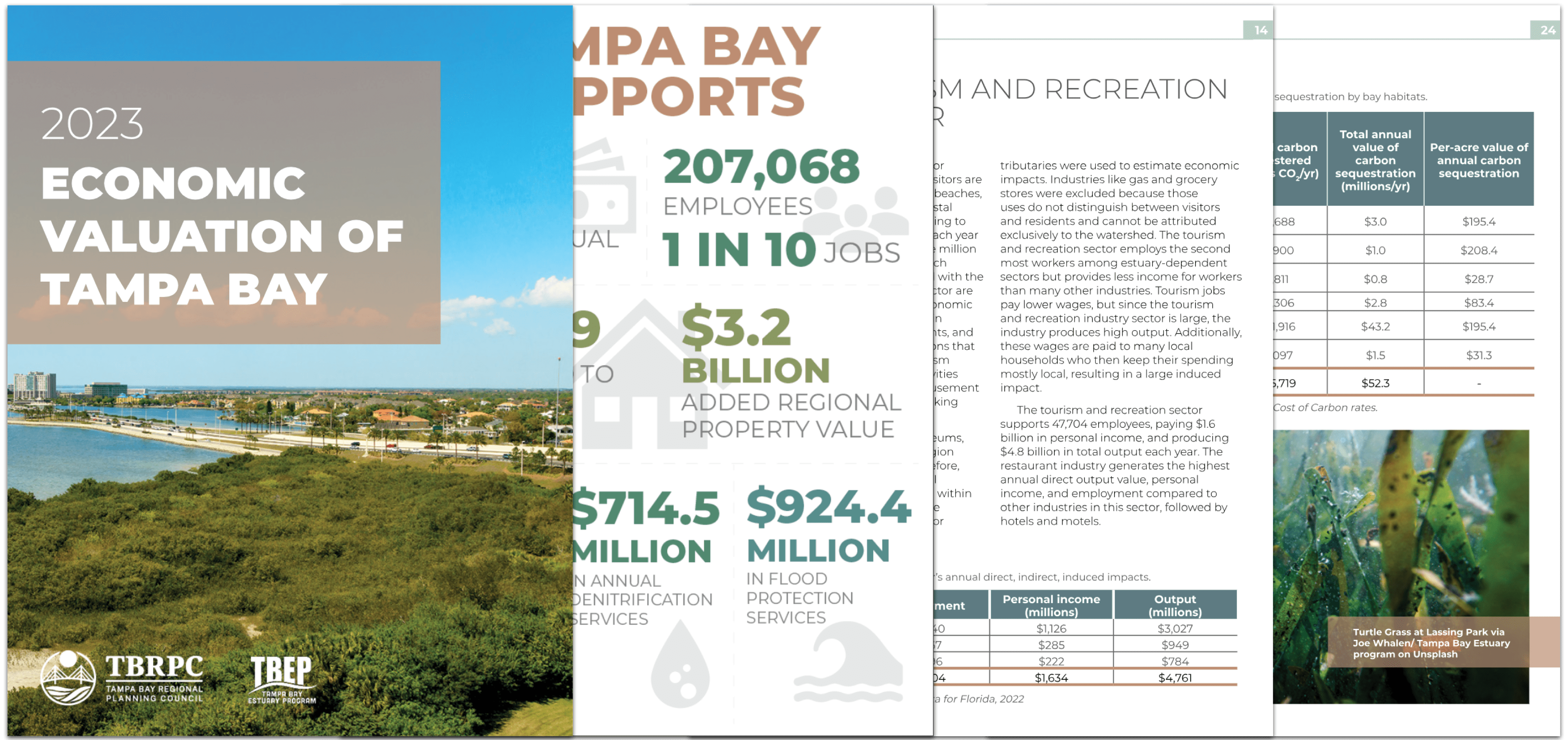
EPA scientists are partnering with local governments, planning organizations, and citizen and business groups to identify and assess the ecosystem services in Tampa Bay. They will focus on how current and proposed population growth and development may impact ecosystem services.
Because the study of ecosystems falls into many different scientific disciplines, ranging from the microscopic scale to landscape ecology and atmospheric sciences, experts from many fields will participate in this study. The research objectives of the Tampa Bay study are to:
- Delineate and quantify ecosystem services provided by the Tampa Bay ecosystem
- Assess the likely changes in environmental stressors and land use patterns through 2050
- Model the relationships among stressors, ecosystem structure and functioning, and ecosystem services
- Place values on Tampa Bay's ecosystem services in terms of human well-being
- Model multiple future scenarios of different land-use changes and projected impactson ecosystem services and human well-being
- Develop a Web-based tool to characterize effects of land use changes on ecosystem services and human well-being
-
Hillsborough River BMAP Coordination
( 0 Articles )
The Florida Department of Environmental Protection (DEP) and the U.S. Environmental Protection Agency (EPA) have determined that a number of Hillsborough County water bodies are not currently meeting state and federal water quality standards, and have designated those waters as “impaired” pursuant to Section 303(d) of the Federal Clean Water Act. The State Legislature, through the Florida Watershed Restoration Act (Section 403.067 Florida Statutes), has identified a process for the development and implementation of Total Maximum Daily Loads (TMDLs) in order to reduce pollutant loading to impaired waters and allow them to meet applicable water quality standards. DEP has identified a process for developing Basin Management Action Plans (BMAPs) in order to achieve TMDLs.
TBEP, EPCHC, Hillsborough County (Public Works, Water, and Planning & Growth Management Departments) and the City of Tampa developed and initiated a process in 2005 with DEP as a Hillsborough County Watershed Management Initiative (WMI), which will take a proactive approach to developing BMAPs for impaired waters within Hillsborough County. The process was facilitated by TBEP and its DEP-funded consultant to help develop six BMAPs that address fecal coliform impairments in the Hillsborough River Basin. The BMAP Work Group has also developed a “decision support tool” to help define management responses to human health risks in these waterbodies. The BMAP Work Group submitted their final draft document in 2008, and FDEP approved the final Hillsborough River Basin Fecal Coliform BMAP in fall 2009.
TBEP, EPCHC, Hillsborough County (Public Works, Water, and Planning & Growth Management Departments) and the City of Tampa developed and initiated a process in 2005 with DEP as a Hillsborough County Watershed Management Initiative (WMI), which will take a proactive approach to developing BMAPs for impaired waters within Hillsborough County. The process was facilitated by TBEP and its DEP-funded consultant to help develop six BMAPs that address fecal coliform impairments in the Hillsborough River Basin. A Draft BMAP for these waterbodies was submitted to DEP in June 2007. The BMAP Work Group has also developed a “decision support tool” to help define management responses to human health risks in these waterbodies.
|